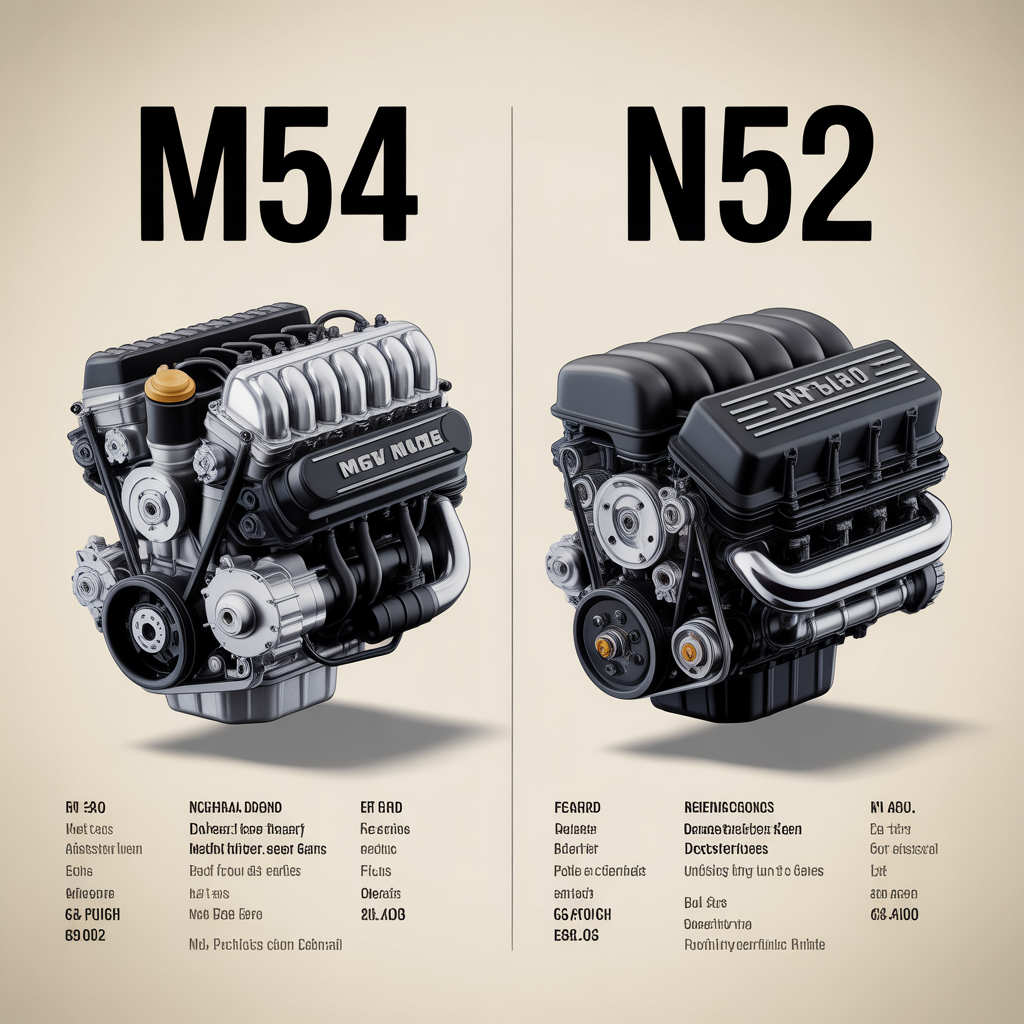
BMW’s naturally aspirated straight-six engines have a loyal following, and two of the most common are the M54 (early-2000s “classic” six) and the N52 (the next-generation NA six with newer tech). If you’re shopping used—or already owning one—this comparison matters because M54 and N52 ownership can feel very different: the M54 is simpler and widely DIY-understood, while the N52 can be more modern and efficient, but sometimes pricier when specific systems fail.
By Gustavoblalmiras
This is only for educational purposes and is not professional mechanical advice. Always follow BMW service information, local regulations, and safe workshop practices.
Both engines can be excellent. The “best” choice usually comes down to what you value most: simplicity and predictable fixes (M54) or newer drivability and efficiency (N52)—plus the condition and service history of the specific car in front of you.
At-a-glance: M54 vs N52
| Category | BMW M54 | BMW N52 |
|---|---|---|
| Typical model years | Early-2000s BMWs | Mid-2000s to early-2010s BMWs |
| Core “feel” | Classic, simple by BMW standards | More modern response/efficiency |
| Big ownership theme | Age-related plastics, gaskets, cooling refresh | Cooling system electronics + Valvetronic complexity |
| DIY friendliness | Usually easier (more “old-school” layout) | Still DIY-possible, but more systems to diagnose |
| Best for | Budget buyers, DIYers, classic BMW feel | Daily drivers wanting newer chassis without going turbo |
Quick overview: what are the M54 and N52?
BMW M54 (naturally aspirated straight-six)
The M54 is an early-2000s naturally aspirated inline-six known for smoothness, strong community knowledge, and relatively straightforward diagnostics. Because most M54 cars are now older, condition and maintenance history matter more than mileage alone.
BMW N52 (naturally aspirated straight-six with newer tech)
The N52 is BMW’s later naturally aspirated inline-six that introduced more modern hardware and control strategies (including Valvetronic variable valve lift on many applications). In the real world, it can feel more “modern,” but certain failures—especially cooling-related—can be more expensive if they haven’t been addressed already.
The big design differences (why they behave differently)
1) Valvetrain and airflow control
- M54: Double VANOS (variable cam timing) with a more traditional throttle-based airflow strategy.
- N52: Double VANOS plus Valvetronic (variable valve lift) in many versions, which can improve efficiency and response—but adds components that must stay healthy (seals, sensors, electrical connectors).
2) Materials and packaging
The N52 is known for lightweight construction and more modern packaging around the engine. In practice, this can improve balance and efficiency, but it also means more “system dependencies” (more sensors, electronic control, and tighter integration).
3) Cooling system strategy (a major ownership divider)
Many N52 applications use an electric water pump, while most M54 setups are more traditional and belt-driven. This doesn’t make the N52 “bad,” but it changes the failure pattern: an electric pump can fail more suddenly and is often replaced together with the thermostat.
Reliability: which one is “better”?
There’s no universal winner. The more honest way to look at it is: which engine is a better fit for your ownership style and the condition of the specific car you’re buying.
- M54 ownership is often easier to budget because the common jobs are well-known (cooling refresh, gaskets, crankcase ventilation, intake flap issues).
- N52 ownership can be very rewarding as a daily driver, but you should assume certain higher-ticket items may come up if there’s no evidence they’ve been replaced (especially cooling components and oil leaks around the top end).
Common BMW M54 problems (what to check)
1) Cooling system aging (plastics, seals, hoses)
On many M54 cars, cooling system components become “age-maintenance items.” If you don’t have receipts for major cooling parts, it’s wise to budget for preventative replacement rather than waiting for an overheat event.
- Clues: coolant smell, slow coolant loss, crusty residue around joints, temperature fluctuations.
2) CCV/PCV (crankcase ventilation) issues
Crankcase ventilation faults can cause rough running, lean codes, oil consumption symptoms, and extra oil leaks. In cold climates, moisture/icing can make symptoms worse on neglected systems.
3) DISA valve wear (intake flap mechanism)
A worn DISA valve can cause rattles, inconsistent idle, and reduced response. Many owners inspect this as mileage climbs because a badly worn unit can create additional intake problems.
4) Oil leaks (common gasket areas)
- Valve cover gasket
- Oil filter housing gasket
- VANOS oil line area (varies by model)
Clues: burning oil smell after driving, oil residue on the front of the engine, smoke from oil dripping onto hot surfaces.
Common BMW N52 problems (what to check)
1) Electric water pump + thermostat (common higher-cost repair)
This is one of the best-known N52 ownership items. If you’re buying used, it’s a big plus to have paperwork showing recent replacement—especially if the car is nearing typical “failure mileage” territory.
- Clues: overheating warnings, odd fan behavior, reduced-power/limp behavior, stored cooling system faults.
2) Valve cover gasket leaks (and valve cover condition)
N52 engines commonly develop top-end oil leaks. Leaks can also affect connectors and sensors if oil contamination spreads, so it’s worth inspecting carefully rather than ignoring “minor seepage.”
3) Oil filter housing gasket leaks
This is a frequent BMW maintenance item across multiple engine families. It’s usually fixable—but the consequences of ignoring leaks (oil on belts, mess, smells) can add up.
4) Valvetronic-related issues (seals/sensors/connector contamination)
Because the N52 often uses Valvetronic, there are extra components near the valve cover area that can be affected by leaks or electrical sensitivity. A clean, dry top end is a very good sign on an N52.
5) Lifter noise (“ticking”) on certain production ranges
Some N52 engines develop lifter ticking, often noticed on short-trip use or cold starts. It doesn’t automatically mean the engine is failing, but persistent noise should be diagnosed correctly (oil condition, service history, and known updates matter).
Which engine is the better choice for you?
Choose M54 if you want:
- A simpler, “classic” BMW straight-six experience
- More predictable, well-documented maintenance paths
- Better DIY friendliness in many cases
Choose N52 if you want:
- A newer chassis while staying naturally aspirated
- More modern drivability and efficiency
- You’re willing to budget proactively for cooling + common oil leak work
Used-buyer checklist (fast, practical)
Before you view the car: ask for service history, cooling system receipts, and any diagnostic screenshots (fault code scans). Verify the exact engine and model year—BMW options vary by market.
- Cold start: listen for abnormal ticking/knocks and watch for smoke.
- Warm drive: confirm stable temperature behavior; no warnings.
- Check for leaks: inspect around valve cover and oil filter housing areas.
- Cooling proof matters: on N52 especially, receipts for pump/thermostat are a major value signal.
- Scan for codes: even if the dash is clear, stored faults tell the real story.
FAQ
Is the M54 more reliable than the N52?
Often the M54 feels easier to own because the common jobs are simpler and very well documented. But reliability depends heavily on maintenance history and whether cooling/oil leak work has been kept up.
Is the N52 a “bad” engine because of the electric water pump?
No—many N52s run for a long time when maintained. The pump is simply one of the more common higher-cost items, so it’s best handled proactively with documentation.
What matters most when buying either engine?
Receipts, coolant/oil condition, leak inspection, a proper test drive from cold to warm, and a fault-code scan.
Sources (for your References section)
https://en.wikipedia.org/wiki/BMW_M54
https://en.wikipedia.org/wiki/BMW_N52

https://static.nhtsa.gov/odi/tsbs/2013/MC-10150095-9999.pdf
https://static.nhtsa.gov/odi/tsbs/2012/SB-10032779-8218.pdf
About the author
Gustavoblalmiras writes educational car-maintenance explainers focused on common problems, ownership checks, and practical used-buyer guidance.